

Deepfakes—from a curiosity to a real threat!
Deepfake technology has evolved dramatically in recent years. From digital experiments, it has evolved into sophisticated tools capable of creating fake yet extremely realistic audio and video content. Using artificial intelligence (AI) and machine learning algorithms, these fakes are becoming increasingly difficult to detect. Today, the deepfake phenomenon is an alarming reality, with risks ranging from political disinformation to online blackmail, fraud, and the erosion of trust in the media.
What are deepfakes and how do they work
The term “deepfake” comes from the combination of “deep learning” and “fake.” The technology is based on generative adversarial neural networks (GANs):
- The generator creates fake images, videos, or audio recordings.
- The discriminator attempts to identify them.
Through repetition, the generator becomes increasingly sophisticated, producing content that is nearly impossible to distinguish from reality.
For video, attackers use hundreds of images and video clips of the target. For audio, a few voice samples are sufficient to mimic the victim’s voice.
Major risks posed by deepfakes in Romania
Disinformation and manipulation of public opinion
In election campaigns or tense social contexts, a deepfake clip featuring a politician can influence votes or discredit public figures. Local
example: DNSC warnings regarding the use of deepfakes in political and election campaigns.
Blackmail and defamation
Deepfakes are used to fabricate compromising material (including non-consensual pornography). Victims may be blackmailed or publicly exposed.
Online fraud and social engineering
An audio deepfake can mimic the voice of a CEO, colleague, or family member to request money or sensitive data. Cases of “CEO scams” are on the rise globally.
Erosion of trust in the media and institutions
The proliferation of fake news and deepfake content leads to distrust in the press and authorities. The public can no longer distinguish reality from fiction.
How to recognize and protect yourself from deepfakes
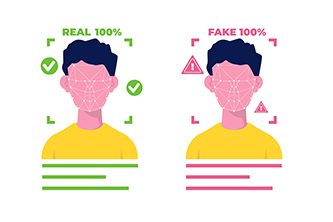
- Check the source and context—avoid content posted by anonymous or unverified accounts.
- Analyze the technical details—imperfect synchronization, inconsistent lighting, voice with unnatural pauses.
- Use critical thinking—if content seems too shocking, it’s probably fake.
- Identify emotional manipulation—deepfakes exploit strong emotions.
- Use detection tools—Deepware Scanner, Microsoft Video Authenticator.
- Educate yourself and others—discuss the risks of AI and digital fakes.
- Report suspicious content—alert platforms or authorities (DNSC, Romanian Police).
Examples and documentation specific to Romania
- Politicians and public figures targeted by deepfake videos.
- “Relative/boss” audio scams using AI-generated voices.
- Official sources: DNSC alerts, SRI, news articles (HotNews, G4Media, Digi24), NGO studies (Funky Citizens, CJI).
A secure digital future depends on our vigilance
The deepfake phenomenon is one of the greatest challenges of the current digital age. Its threat to truth, trust, and personal security is real and growing. Only through digital education, critical thinking, and constant vigilance can we limit the impact of these technologies.
For IT & C products, we recommend our specialized store—Altamag.ro
VIEW STORE


